
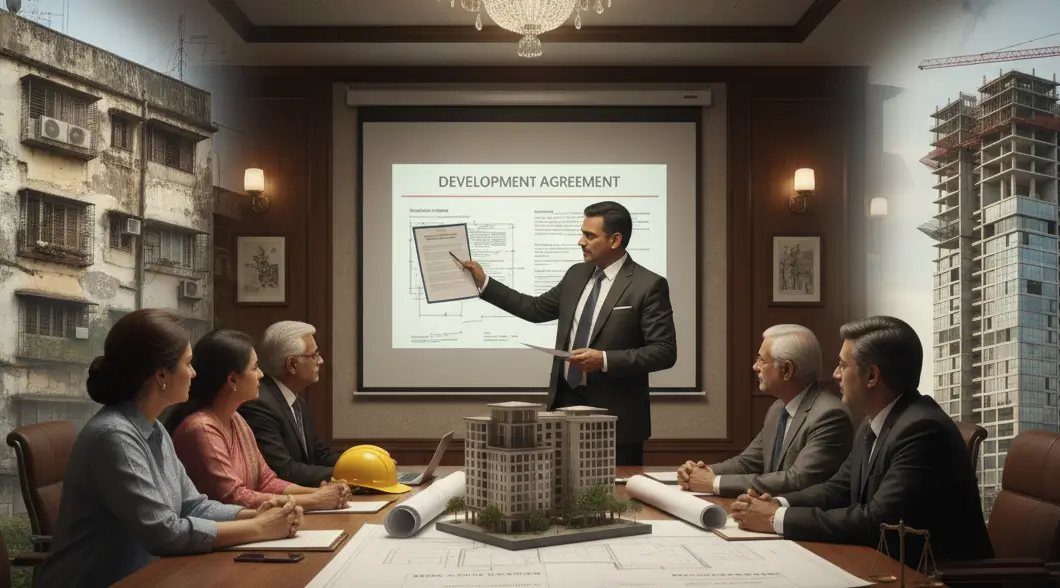
- The State can issue directions for redevelopment under Section 79A of the Maharashtra Co-operative Societies Act (MCS Act) — societies must follow those directives and model bye-laws when redeveloping.
- Member consent: redevelopment requires members’ approval — practice and recent government SOPs use a majority/threshold requirement (widely applied threshold cited in guidelines and reporting is 51% written consent to start the process, though exact voting/bye-law formalities must be checked for your society).
- Municipal / development approvals (building sanction) are essential (MCGM/Pune/other local body) — redevelopment cannot proceed without sanctioned plans under the applicable Development Control Regulations (DCR/UDCPR). MHADA / DCR provisions (e.g., DCR 33(5) in Mumbai) and local municipal rules apply.
- MahaRERA generally governs the sale component of redevelopment projects (i.e., flats sold to outsiders/investors). Rehabilitation portion for existing members is usually outside the RERA regulated sale component but registration obligations may apply for the sale portion. Check MahaRERA requirements for your project.
Step-by-step Practical Process for Redevelopment of Society:

1. Preliminary assessment & feasibility
Get a structural engineer / architect report (building condition, life/safety), legal title search, and a high-level feasibility (FSI potential, additional saleable area, expected accounting for members).
2. Form a Redevelopment Committee
Elect a small committee (as per bye-laws) to manage the process and interact with experts/developers. Obtain committee authorisation at a General Body Meeting (GBM).
3. Member approvals — notice & Special General Body Meeting (SGBM)
Convene an SGBM with full disclosure (developer offers, pro-forma agreements, alternate accommodation plan, timeline, bank guarantees). Secure the required written consent/vote (commonly 51% consent for redevelopment proposals in practice — confirm your society bye-laws and any updated government circular). Keep minutes and resolutions precise.
4. Call for proposals / select developer
Either invite tenders/RFPs or negotiate with a developer. Evaluate: track record, financial strength, construction bank guarantees, proposed consideration (alternate flats/cash), timelines, and escrow/accounting arrangements. Insist on performance guarantees and timeline milestones in the development agreement.
5. Draft & sign Principal Agreement / Development Agreement (DA)
Key clauses: scope, built-up allocation for members, timelines, temporary accommodation/leaseback, corpus funds, escrow accounts, indemnities, guarantee/bank guarantee, dispute resolution, phasing, transfer of shares, stamp duty & tax allocation, handing over procedure. Get the DA and ancillary POAs reviewed by a lawyer. (Stamp duty issues have attracted litigation — get exact computation checked.)
6. Statutory approvals
Developer/society must obtain sanctioned plans from the local municipal authority, MHADA/NOC if triggered, environmental/other NOCs as applicable. If additional FSI/transfer certificates are used, comply with DCR/UDCPR provisions (e.g., Mumbai DCR 33(5)).
7. RERA & sale component
If the developer sells flats to third parties, those sale units generally must be registered with MahaRERA (developer’s responsibility). Ensure RERA registration & disclosures for the sale portion are in order.
8. Implementation: alternate accommodation & construction
Address temporary accommodation: on-site transit tenements, alternate accommodation nearby, or cash/lease options — spelled out in the DA. Monitor construction, enforce bank guarantees and escrow rules, get periodic reports and joint site inspections.
9. Handover, new share certificates, alteration of bye-laws
On completion, new flats / share certificates are allotted; society records and bye-laws may need amendment and re-registration. Ensure final satisfaction certificates and occupancy certificates are obtained before handing over possession.
10. Post-completion compliance
Transfer of title for sale units, closing accounts, corpus fund receipts, updated society register and statutory filings with Registrar of Co-op Societies.
Short checklist you can use at the first SGBM
- Structural engineer report and title search: Yes / No
- Draft development agreement available: Yes / No
- Developer credentials & bank guarantee shown: Yes / No
- Alternate accommodation plan and timelines: Yes / No
- Estimated allocation to members (sq.ft. / built-up): Yes / No
- Sanctioned plan strategy (DCR/FSI): Yes / No
- RERA registration plan (if sale to outsiders): Yes / No
- Stamp duty / tax clarity from advocate: Yes / No

Common pitfalls & how to avoid them
- Vague DA terms (no timelines/milestones): insist on liquidated damages and bank guarantees. redevelopmentofhousingsocieties.com
- Choosing developer on friendship alone: vet the developer’s track record, financials, & past completion history. The Times of India
- Skipping proper member disclosure: non-disclosure leads to later disputes; circulate full papers in advance. mysocietyclub.com
- Ignoring municipal/DCR complications: redevelopment schemes differ by local authority (Mumbai vs Pune vs other municipal corporation). Confirm DCR/UDCPR applicability. MHADA